
Address component analysis: A smarter way to validate addresses
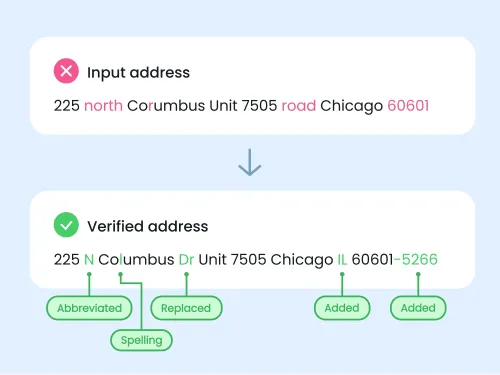



Most address validation tools give you a simple thumbs up or down on an address because it either matches or it doesn’t, right?
But what if you need more than just “valid” or “invalid” as a response? What if you could know exactly what part of the address is off, like a misspelled street name or an unconfirmed vanity city (like Hollywood), and why it isn’t considered valid?
What if part of an address needed to change in order to make it a mailable, valid address?
We think you’d want to know that, too.
That’s the power of address component analysis, a next-level feature included in select Smarty US Address Verification and US Rooftop Geocoding subscriptions.
What is address component analysis?
Address component analysis is how you can evaluate each individual part of an address, like street name or ZIP Code, etc. Part of Smarty’s enhanced address validation mode, address component analysis reveals:
- Whether a component is confirmed, unconfirmed, or missing
- What was changed (e.g., spelling, abbreviation, added)
- An explanation of why the change was made
Think of it like X-ray vision for addresses. Instead of looking at the whole address and guessing what’s wrong, you get pinpoint accuracy zoomed into the broken component for more accurate strategy when developing your business logic surrounding addresses entering your database.
How address component analysis works
When enabled via enhanced mode in select US Address Verification or US Rooftop Geocoding plans, Smarty analyzes and reports on each component.
Take this input address, for example: “100 Centrl Street, Rear 02035.”
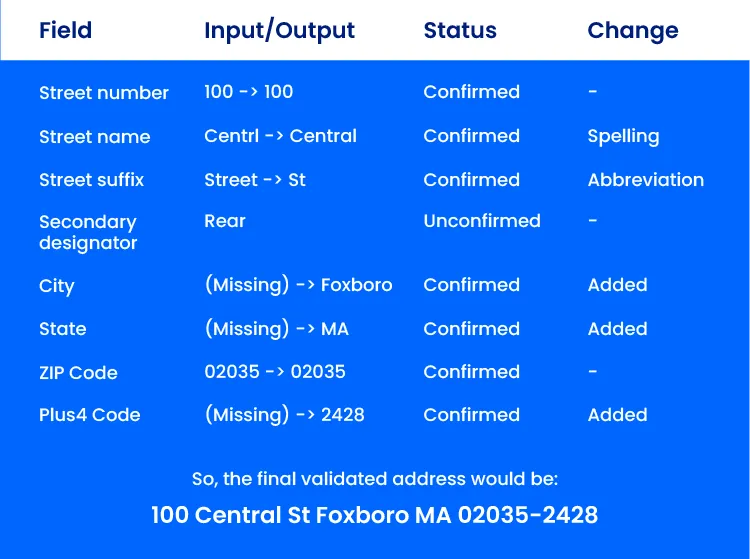
And you’d know exactly what changed to get there using address component analysis.
How to interpret address component results
When Smarty parses an address and applies component analysis, you’ll see fields like:
- status: Shows if the component is confirmed, unconfirmed, or missing.
- change: Explains what transformation occurred: added, spelling, abbreviation, replaced, etc.
Example JSON snippet:
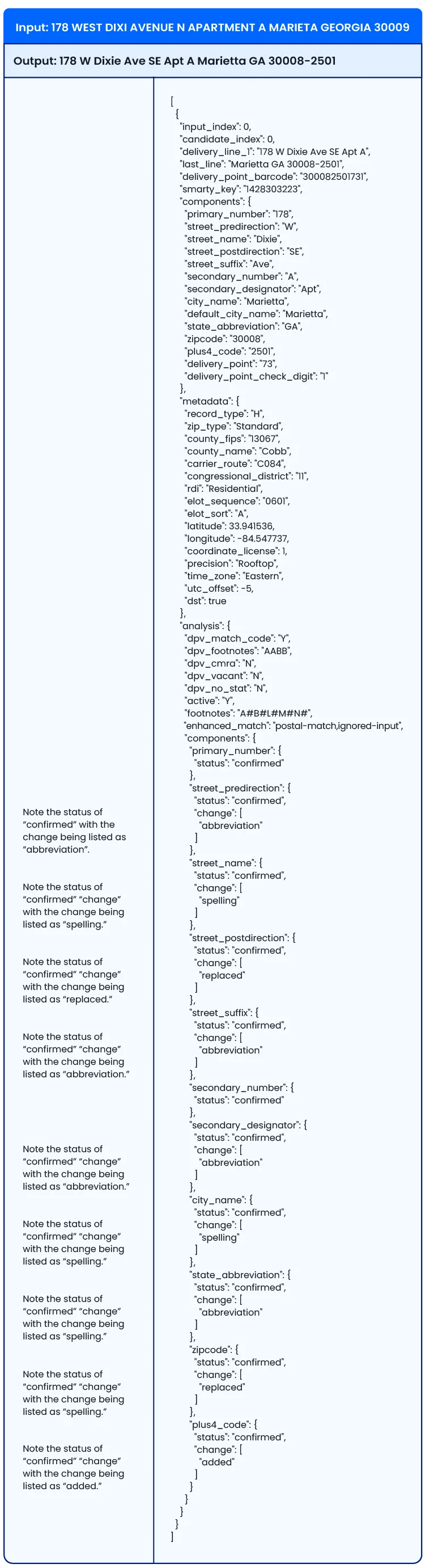
In the instance where the change was noted as “abbreviation,” Smarty standardized the address components to meet local postal requirements:
- The street predirectional entered “WEST” → was standardized to “W”
- The street suffix entered “AVENUE” → was standardized to “Ave”
- The secondary designator entered “APARTMENT” → was standardized to “Apt”
- The state abbreviation entered “GEORGIA” → was standardized to “GA”
When the change was noted as “spelling,” Smarty fixed the spelling in order to find a match.
- The street name entered “DIXI” → was corrected to “Dixie”
- The city name entered “MARIETA” → was corrected to “Marietta”
Every instance of “replaced” denotes that Smarty had to entirely replace an entered component in order to obtain a match.
- The street postdirectional entered “N” → was replaced by the correct one, “SE”
- The ZIP Code entered “30009” → was replaced by the correct one, “30008”
And finally, a little bonus for our users, every change noted as “added” means that Smarty is enriching your address with extra data that might be useful to improve mailability.
- The previously missing plus4 code → added for your convenience as “-2501”
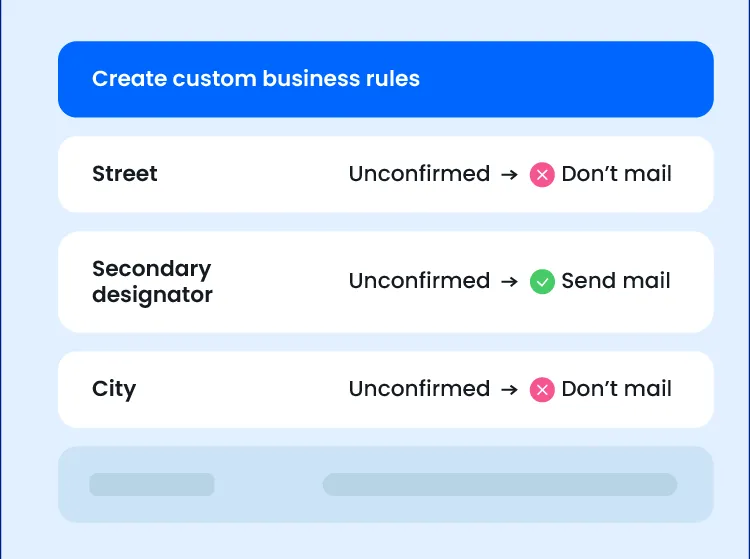
One way to use this data is to define custom business rules, like “don’t ship if the street or city is “unconfirmed,' but do ship if only the secondary designator is unconfirmed.”
Benefits of address component analysis
1. Precision-level control
You’re not flying blind with a red “X” on the whole address. Now, you know what changed and why, allowing you to have granular control over your data and the decisions you make based on it.
2. Smarter operations
Use rigorous confirmation logic for mailing, shipping, form acceptance, or compliance—without forcing an overall pass/fail judgment call and potentially missing out on reaching your full audience.
3. Cleaner third-party data
Audit purchased or uploaded address lists by identifying how often and where corrections are made, down to the building number or ZIP+4.
4. KYC/AML flexibility
For financial or regulatory use cases, validate addresses at the component level to meet Know Your Customer (KYC) and Anti-Money Laundering (AML) compliance without over-validating and cutting out potential business or areas of operations.
5. Better customer experience
Show users exactly which part of the address they got wrong. That reduces form abandonment, frustration, and unnecessary support tickets.
Real-world use cases
- Insurance underwriting: Flag addresses with unconfirmed ZIP Codes or cities before issuing quotes.
- Healthcare systems: Avoid mismatches that could prevent record syncing or claims processing.
- Retail shipping: Customize logic—allow shipments with unconfirmed unit designations, but stop shipments missing unit numbers.
- Logistics routing: Ensure deliveries or service trucks aren’t dispatched without confirmed unit numbers.
- Data science teams: Use the status and change fields to enrich models, flag anomalies, and boost accuracy in data pipelines.
Where to get address component analysis
US Address Verification subscriptions include address component analysis when you enable “enhanced mode” in select core plans. It’s also supported in our US Rooftop Geocoding services for precise location intelligence.
If you’re a Smarty customer and have a qualifying subscription, there’s no need to change your integration if you’re already using enhanced mode. Just set the features parameter equal to “component-analysis” and it’ll just start working like magic. See the technical doc for more details.
TL;DR: Why component-level analysis matters
Address validation that doesn’t tell you what’s wrong is like a spellchecker that says “there’s an error” but won’t tell you where. Smarty’s address component analysis gives you:
- Transparent, component-level insights for every address
- Greater operational control
- Cleaner, more compliant data
- Better user experiences
Want to level up your address intelligence? Get in touch with our experts or try out Smarty’s APIs.