
Why insurtechs need to help insurance agencies with prefilling apps




If you’re an insurtech company, here’s something you might not have high on your roadmap, but should: application pre-fills.
Most insurtechs are focused on the big-ticket items—policy management, quoting engines, claims systems, or risk modeling. And those are excellent, worthwhile ventures.
But if you want your insurance carrier clients to really win (and keep renewing with you), you need to help them solve one of their biggest CX + compliance pain points: the insurance application process.
Here's what you can expect to learn about in this blog:
- The upside of smarter prefilling
- The cost of bad application data
- Better prefilling starts with better address intelligence
- Prefill for compliance, not just conversion
- Property data = commercial app game-changer
- Don't leave core systems halfway integrated
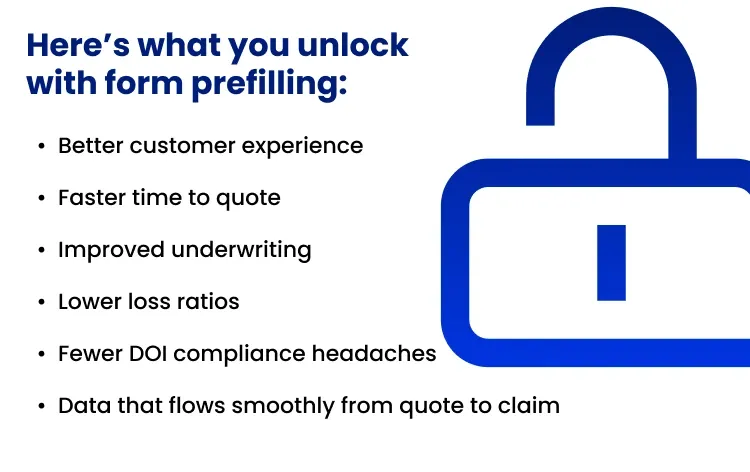
- TL;DR: why this matters
The upside of smarter prefilling
Insurance carriers care deeply about filling out their applications quickly, accurately, and with as little friction as possible. The reasons are obvious:
- Faster time to quote
- Fewer application abandons
- Lower loss ratios (because better data = better underwriting)
- Better customer experience
- Stronger compliance posture
If you’re building or integrating any kind of core system, from rating and quoting to claims and renewals, a strong prefill experience is table stakes, and the best ones start with address data.
Why? Because bad data is expensive.
The cost of bad application data
Insurance apps can be long and brutal. If the insured gets the address wrong or doesn’t know how to answer property-specific questions, you have a ticking time bomb for insurance companies. Because bad address or property data points lead to bigger, more costly problems for these carriers and their organizations, it should be your job as the insurtech to help them minimize those costs and win over their business.
Inaccurate address data can cost insurance carriers up to 15–25% of their total revenue. Insurtechs can help to minimize that number by bolstering their platforms with accurate address data, combating incorrect coverage, delays in quoting and onboarding, exposure to compliance risk, and underinsurance for the insurance carriers who use them.
Incorrect coverage rates

If a customer enters a ZIP Code in a form on your platform, but they’re off by 1 digit, it might not seem like a big deal at first, but ZIP Codes are often tied to specific underwriting zones for fire, flood, or windstorm risk.
A ZIP Code determines fire protection class ratings, and an incorrect one can alter a property’s fire risk category, which alters the coverage eligibility and premium pricing for an insurance carrier’s provider.
Flood zones are mapped by address, and misplacing a structure can lead to missing flood insurance requirements.
Similarly, a change in elevation of 500 ft. can alter a property’s risk category in more ways than one.
Any of these issues create an incorrect coverage rate, leading to expensive legal battles, customer service hours, damaged brand reputation, and more for the insurance carrier who relies on your organization for accuracy.
Delays in quoting or onboarding due to manual corrections
Manual corrections = friction.
Friction = drop-off.
When a customer or broker enters an address that can’t be validated or doesn’t autofill correctly, the application process slows to a crawl. All of a sudden, we’re in manual process and corrections land.
Underwriters may now need to verify locations manually.
They may also have to track down applicants to clarify discrepancies (and we all know how much everyone loves answering the phone from a number they don’t know).
Every additional step in the quoting process increases the likelihood of abandonment. The industry average for digital insurance forms shows drop-off rates as high as 70% when forms aren’t auto-filled or verified. Ouch.
This is expensive for insurance carriers because of customer service hours being billed for angry people wanting answers about why it’s taking so long to get a quote, the opportunity cost of not being able to write and close more policies while this one is in limbo, and the potential damage to brand reputation.
Exposure to compliance risk
Being off by even one block can make an insurer issue a policy in a jurisdiction where you’re not licensed or where different rate filings and regulatory disclosures apply.
Departments of Insurance (DOIs) conduct audits to ensure compliance with rate filings, disclosures, and territory-based guidelines. Writing business in a jurisdiction where you’re not approved can lead to fines, customer restitution, or rescinded policies. Too much of that can damage the brand's reputation.
Better prefilling starts with better address intelligence
Smarty’s products were practically built for this moment. With our suite of address tools, you can help insurance carriers do all of the following in their forms, portals, or quote software:
- Autocomplete input valid addresses at the point of entry. As users start typing an address—whether it’s in the U.S. or international—our autocomplete tool instantly shows only valid, verified suggestions in a dropdown. From the very first letter, results are filtered based on your chosen settings to help users fill out forms quickly and correctly. Once they pick an address, the rest of the form fills in automatically. This speeds things up, reduces errors and drop-offs, and gives your customer experience and ROI a boost. (Bonus points if you use this on your internal forms as well to streamline your internal processes.)
- Validate US and international addresses against authoritative sources (like USPS and more). Address verification ensures that only real, complete, and valid addresses exist in your databases, so if one number is off on a submitted ZIP Code, an insurance agent’s underwriting team will be flagged and know to dig deeper for the correct information. Insurance carriers also want to deduplicate their databases to avoid fraud and misdelivery of important policy documentation, and SmartyKey® (our persistent, unique identifier) tracks address changes and identifies alias locations for a smoother deduplication process.
- Geocode to the actual rooftop, not just the parcel center, ensuring that your insurance carriers will have exact elevation records, distance to coast, fire risk, and any detail they might need to write the most accurate policies and take on the least amount of risk.
- Enrich with 350+ property attributes like structure elevation, construction type, and historical market activity to streamline complicated application processes and conduct thorough asset analysis (Hello, better risk models.)
- Assign persistent IDs (SmartyKey®) that track a location over time, regardless of address changes, and can be used in perpetuity. This will help your insurance carrier customers to seamlessly blend noisy, messy, aggregate data from anywhere.
When you combine verified addresses with 350+ property data points, you’re providing insurance carriers with the tools they need, the ease they require, and the speed they crave to make them rise a level above their competition. Signing up on your platform is a no-brainer.
Prefill for compliance, not just conversion

Sure, autocomplete helps increase form conversion. But the real power lies in compliance. An inaccurate or incomplete address isn’t just a data problem—it can mean unauthorized policy issuance, misrated premiums, or missing required disclosures.
- Validate the full address down to secondary units
- Warn if required apartment/suite info is missing
- Never “fix” bad data silently (avoiding false positives here)
- Alert when geocodes don’t match the entered address
That means when an address hits a policy system, it’s clean, accurate, and regulatory-ready, even if the address has changed over time.
Property data = commercial app game-changer
For commercial insurance, especially, property data is a secret weapon. These applications often ask things like, “What’s the building square footage?”, “Is there a detached garage?”, and “What’s the year built or last renovation?”
Most insureds don’t know the answers—or they guess. With Smarty’s property data, insurers can potentially prefill these fields automatically, saving time and reducing the risk of bad inputs.
It’s always easier to ask, “Is this right?” than “Can you fill this out from scratch?”, and Smarty’s tools can empower you to provide that for your insurance carriers.
Don’t leave core systems halfway integrated
Whether your insurtech platform is powering quotes, claims, underwriting, or CRM, each “hub” needs the right data engine humming under the hood.
We’re already baked into major platforms like Guidewire, Sapiens, Cytora, and EigenRisk. That means we’ve been battle-tested with real-world integrations, high volumes, and tough regulatory environments.
If you're building anything in insurance that touches addresses, make sure it's plugged into Smarty.
TL;DR: why this matters
Insurtechs can win major loyalty (and wallet share) from insurance carriers by making form prefilling smarter and more compliant.
Want to see how your app or core system could benefit from accurate address and property data?
Let’s talk. Or just try it out today with our free tools.